Showing posts with label Saints. Show all posts

Thursday, March 11, 2021

Greatness

Today (March 12th) is the feast of St. Gregory the Great, and just his name begs a queue of questions -- not about whether St. Gregory deserves the appellation (of course he does!), but more about the honor of the title itself. Don't you wonder? First of all, what makes for the distinction, considering there are so many saints we might also think of as great who don't get 'the Great' as part of their legacy? Is it an official title conferred by the Church? How many Greats are there, and do they come from all different strata of Church life or are they all "big wigs" in the hierarchy?

I had a hard enough time just trying to remember more than two or three saints called "the Great," so, as a public service -- and because I was just curious -- I grabbed my deer slayer hat and took my magnifying glass to the internet, and this is what I found:

* Though it seems there is a list of popes at the Vatican (the Annuario Pontificio) that does distinguish the Greats among the Successors of Peterthe Church never officially pronounces saints as “great”; rather, those whom we know by the title have won the honor by popular acclaim at the time of  death and later earned them in perpetuity by the acclaim of history itself. When the moniker, sometimes applied out of the affection of a saint's contemporary society, stands the test of time and the objectivity of distance and comparison, the saint is officially unofficially one of "the Greats."

* There are seven holy men and women of the Church who have thus stood the test and become universally acclaimed the Greats of the Roman Catholic calendar Though there may be more, these are those most universally recognized.


Three Popes: Pope St. Leo I (reigned 440–61 AD); Pope St. Gregory I (590–604  AD); and Pope St. Nicholas I (858–67 AD). 

Two bishops: St. Albert the Great (aka 'Albert Magnus,' c.1200-1280 AD) and St. Basil the Great (aka 'Basil of Ceasarea,' c.330-379 AD)

One abbot: St. Anthony the Great (aka 'Antony of the Desert,' 251-356 AD)

One Abbess: St. Gertrude the Great (aka 'St. Gertrude of Helfta,' 1256-1302 AD)


One motive for persisting in the Great reference for some saints is that of providing distinction between two saints of the same name. For instance, St. Gertrude, the only female called Great, received the title from Pope Benedict XIV to differentiate her from Abbess Gertrude of Hackeborn, who was the elder sister of St. Mechtilde and abbess of St. Gertrude the Great's convent, but she left no writings, and is not a canonized saint.  A good abbess and holy woman, to be sure, but the abbess didn't merit the acknowledgement from the pope as our St. Gertrude did. 

St. Anthony the Great -- perhaps more commonly known as St. Anthony of the Desert -- earned several other distinguishing titles to prevent confusing him with St. Anthony of Padua: Anthony the Abbot, Anthony of Egypt, Anthony the Hermit, and Anthony of Thebes, but the title of Great is a well-earned asterisk considering he is known as the Father of All Monks, one of the founders of Christian monasticism. 

But What is Greatness?

Seeing as all saints (in my mind, anyway) are great, the next question has to be: what was it exactly that made these saints, popes, bishops, abbot and abbess, stand out in their greatness? All the accomplishments and virtues of these seven would fill the big walnut tree in my backyard, but here are some nutshell possibilities to consider:

St. Albert the Great 

Popularly known as the teacher of the great St. Thomas Aquinas (the consummate theologian, the Angelic Doctor, who did not get the sobriquet) -- and not as a bishop, St. Albert was appointed the bishopric of Regensburg, Germany, by Pope Alexander IV in 1260. 

Due to the difficulty of maintaining his Dominican vows of humility, however, he resigned the post with permission of Pope Urban IV after only three years . The story goes that he felt riding a horse incompatible with this vows, so he walked the length and breadth of his large diocese in his zeal for his people, but felt unsatisfied that he provided for them adequately. (Can you imagine?) Humble to a fault, St. Albert earned the laud of centuries of Catholics for his great learning, his successful diplomacy, and his passion for education of all kinds, but especially in theology (and especially amongst his Dominicans). He was known in his time, as well as in our own, as a scientist, philosopher, astrologer, and spiritual writer.  How could we think of the teacher of St. Thomas as anything less than Great?


St. Anthony the Great 

Known as the Father of All Monks, he was not the first ascetic, but he was the first to escape to the wilderness (c. AD 270) to live a life devoted to prayer and sacrifice -- and lead others to do likewise. The biography of his life by Athanasius of Alexandria is credited with spreading the concept St. Anthony's type of monasticism throughout Western Europe, otherwise little would be known of this holy monk who purposely hid from the world. It is known through Athanasius that St. Anthony ate only bread, salt, and herbs. He drank only water and never took of meat or wine. He ate only once a day and sometimes fasted for several days. He was periodically beaten by demons in the shapes of fantastic beasts, sometimes to within an inch of his life. Though he struggled to remain solitary, a scattered group of followers began to set up "camps" near his hermitage and begged him to lead them also to holiness. In sympathy, and no doubt at the prompting of the Holy Ghost, he agreed to lead them, and spent the next five or six years organizing and teaching the great number of monks that had sprung up around him -- then retired to the inner desert between the Nile and the Red Sea where he spent the last 45 years of life in solitary prayer and penance. How could we not call the Father of Monks Great?

St Basil the Great

A Greek bishop of Caesarea, St. Basil was an important theologian  of the early Church who championed the Nicene Creed at the Council of Nicaea. He fought all the chief heresies that beset the early Church, including Arianism and the errors of Apollinaris of Laodicea. He was instrumental in laying out the guidelines for monastic life. Laying the foundational groundwork for monasticism in the Church, he founded (with the help of his widowed mother and sisters) a monastic settlement on his family's estate near Annesi. His writings about monastic communal life became instrumental in the development of the monastic tradition, particularly in the Eastern Church. 

Together with St. Gregory Nazianzus, he collected within the Origen's Philocalia a large portion of the historian's works documenting the early Church. When he was bishop of Caesarea, he personally organized a charitable kitchen for the poor during a famine and gave away his personal family inheritance to help the poor. We know from his letters that he worked to reform thieves and fallen women. He took personal interest in the selection of candidates for Holy Orders, personally chastised civil officials when they failed in their duties -- and preached to large congregations every morning and evening in his own church. St. Gregory Nazianzus who knew him well compared him to the seven wonders of the world. And if St. Gregory doesn't know Greatness, who does?

St. Gertrude the Great

Part of the confusion between Gertrude of Hackeborn and St. Gertrude the Great lies in the fact that Gertrude of Hackeborn was the Abbess of the Convent in Helftla when our St. Gertrude (the Great one) entered in the year 1260 at the age of 4 (most likely having been orphaned, but it is a debated point). St. Gertrude the Great was mentored under the renowned St. Mechtilde (patron saint of Church music), and reportedly joined the convent itself (Benedictine or Cistersian? It is also debated) at the tender age of ten. By all accounts, however, she was a phenomenal child, taking naturally to Latin and a large range of common course studies. 

At the age of 25, however, her priorities changed to studies of theology and scripture when she experienced the first of a series of visions that continued throughout her life. She became one of the great mystics of the 13th century, devoting her time to prayer and meditation and to writing spiritual treatises for the benefit of her monastic sisters, several which survive today, including her Spiritual Exercises and many sections of a book called The Herald.  She was one of the first devotees of the Sacred heart of Jesus, promoted amongst her Religious Sisters the notion of "nuptial mysticism" -- or being "Brides of Christ," and shared her tender regard for the suffering souls in Purgatory in her writings and her personal urging. She is well known for the following prayer: 

Eternal Father, I offer Thee the Most Precious Blood of Thy Divine Son, Jesus, in union with the Masses said throughout the world today, for all the Holy Souls in Purgatory, for sinners everywhere, for sinners in the universal Church, for those in my own home and in my family. Amen.  

St. Francis DeSales and St. Philip Neri both benefitted by St. Gertrude's revelations and prayers, and Dom Prosper Gueranger (famously, the author of The Liturgical Year and the restorer of Benedictine monasticism in France) owed his gratitude to the influence of St. Gertrude's writings. Her life, spent over 750 years ago, has never stopped influencing seekers of the Spiritual Life. That is true Greatness.

Pope St. Gregory the Great


Another Roman pontiff born in Rome, Pope St. Gregory was born in AD 540 to a wealthy Roman family that was also devoutly Catholic. His mother, Sylvia, and two paternal aunts are honored as saints. A prefect of Rome first, Pope St. Gregory did not enter the Religious life (the Benedictines) until after the age of 33. He was chosen to be a papal deacon by Pope Pelagius II in 578, was papal nuncio to the Byzantine court from 579-585, and, finally, was elected and consecrated pope (by unanimous decision) in 590 AD. His pontificate was distinguished throughout with greatness. In his Liber Regulae Pastoralis, he detailed the specific duties of bishops, he recorded many lives of the saints in his Dialogues, and is recorded as having reformed clerical discipline, removing bishops and priests from office where necessary. He was responsible for peace treaties among barbarian invaders, converting many, and commissioned many groups of missionaries, notably to the British Isles through St. Augustine of Canterbury; St. Colomban who converted much of France; and St. Leander who freed Spain from the Arian error of the Visigoths.

He restored clerical discipline, removing unworthy bishops and priests from office. He protected the Jews from persecution. He fed those who suffered from famine and ransomed those captured by barbarians. He negotiated peace treaties with the barbarian invaders, converting many of them. He instituted the Gregorian chant and to him is attributed the practice of offering thirty Masses for the repose of a soul after death. He is one of the 33 Doctors of the Church and is considered the final Western Church Father.


And this just hits the highlights. The list goes on and on -- and can only lead us to conclude that Pope St. Gregory is, indeed, one of the Greatest of the Greats.


Pope St. Leo the Great
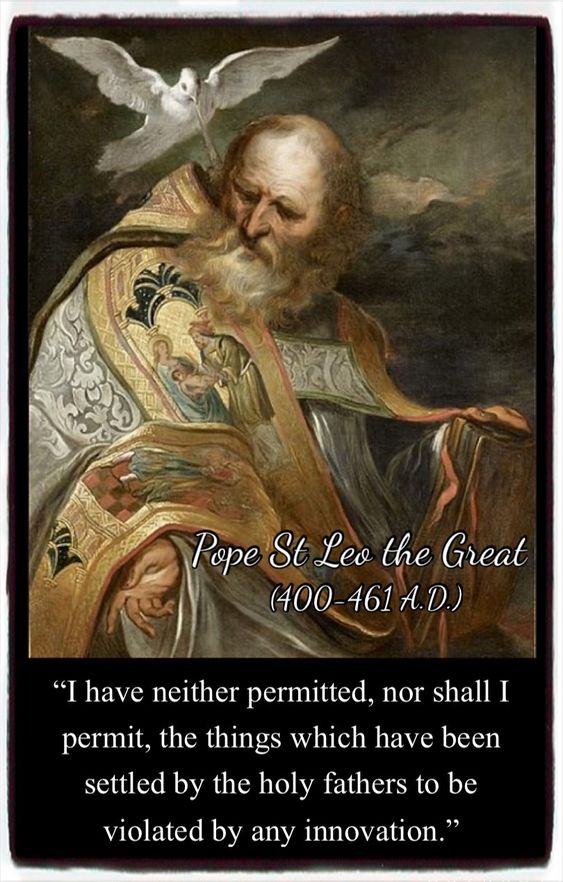
Born a citizen of Rome in the early fifth century, Pope St. Leo succeeded Pope Sixtus III in AD 440. He fought tirelessly against the early heresies of Manichaeism, Pelagianism, Priscillianism, and Nestorianism, and is especially known for his labors against the heresy of Eutyches, which denied the hypostatic union (the divine and human natures united in the divine Person of Christ). He called the Council of Chalcedon in 451 to cement Catholic teaching in the matters of the Incarnation. 

A leader of courage and faith, Pope Leo met Attila the Hun (known as "the Scourge of God") face to face in AD 452 and by the grace of God prevented the destruction of Rome. The story that survives the centuries is that at the meeting Attila saw Saints Peter and Paul wielding swords above  the head of Leo, and this ominous threat motivated Attila to retreat. Ever after, Leo was known by his people as “the Shield of God.” As the Roman Empire declined, Leo sought to strengthen the Church: he suppressed any surviving pagan festivals and closed all remaining pagan temples; he sent missionaries to Africa, then under the threat of barbarians; and he instituted many  needed reforms, including defining the roles of bishops under stricter discipline.  One of the hammers of heretics, Pope St. Leo provided not only guidance and leadership in the midst of heresy, but courage and miracles in the face of worldly danger. Truly a Great!


Pope St. Nicholas the Great

Another "not-to-be-confused-with" saint, Pope St. Nicholas was born c. 820 and has nothing to do with hanging stockings by fireplaces. Not merely a native of Rome, he was practically raised in the Vatican. Because his father was an official in the papal administration, he received his educated at the Lateran, then served in the papal administration, himself, under Pope Sergius II. He was later ordained a deacon by Pope Leo IV, became an advisor to Pope Benedict III, and upon Pope Benedict's death in 858, replaced him in the See of Peter. Well known for his charity and justice, Pope Nicholas denounced the king of Lorraine for attempting to divorce his legitimate wife to marry his mistress, and in the midst of resistance within the Church's hierarchy to bend to civil constructs, he remained firm. With the same resolve, he protected the rights and authority of the papacy at a time when secular rulers sought to control the Church, never hesitating to take decisive measures against them. Pope Nicholas was also a champion of the poor, a supporter of sacred art, and a reformer of clergy and laity alike. He sent missionaries to Bulgaria and Scandinavia under the leadership of St. Ansgar. Though a difficult time in the life of the Church, Pope St. Nicholas represented Christ on earth with the highest personal integrity, dying on November 13, 867 after nine years as Vicar of Christ. His guardianship of the Church, a job requirement of the papacy ignored since Pope Pius XII, amounts to true greatness.

A Great Gift to Us All

What all saints have in common, but especially The Greats, is that they were -- as GK Chesterton says in the quote on the right -- antidotes, not just of their particular time, but of all future times in the history of the Church. They offered what souls needed in their ages, and sometimes they cracked the whip on the Church, itself, when it needed to pull back on track. From the beauty of Gregorian chant to the devotion to the Sacred Heart to the examples of the guardianship of the church and the founding of ascetic and communal monasticism, every one of these Greats made permanent contributions to souls -- and to civilizations. They were a gift to our ancestors and to us, as well. 

My prayer is that we live to see the next Great and that he or she will be the antidote to the problems of our crazy times -- but most especially that they'll lead individual hearts, one by one, to God. St. Gregory the Great, please intercede for us!


* Please forgive the wacko fonts. Blogger is giving me all kinds of trouble in this regard lately! I'm not sure why. If anyone is having similar issues, let me know if you know what the solution is, please!

Wednesday, December 3, 2014

The Feast of St. Barbara!


St. Barbara is one of the Fourteen Holy Helpers, one of the early martyrs of the Church, famed for her legendary courage, and her unusual patronage.  Her life story is one of those recorded in the Golden Legend, but here it is in a nutshell:  St. Barbara, the daughter of a rich man, lived some time during the fourth century. Though her father was a heathen -- and determinedly so -- Barbara learned of the Faith and adopted it secretly.  When her father (surely of choleric temperament) discovered her, he, himself, turned his daughter over to the Roman authorities, and it was at his hands that she was martyred -- by beheading. (Can you imagine?) On his way home after this cruel act, her father was struck by lightning and his body completely consumed by fire.  Barbara, in the meantime, enjoyed the beatific vision and eternal happiness in Heaven.  Her intercession was immediately accompanied by miracles and her fame and expample spread thoughout Christendom. 

St. Barbara is the patron saint of artillerymen, military engineers, gunsmiths, and miners, and is invoked against lightning storms and sudden, violent death in the workplace.  Her cultus exists today in an unusual way through her particular patronage in the military:

St. Barbara's Day is celebrated by the British Royal Artillery, the Australian RAAF Armourers, the Royal Canadian Artillery, the New Zealand RNZAF Armourers, the Irish Defence Forces Artillery Regiments.  The American Third Texas Light Artillery celebrates the Feast of St. Barbara in a special way with a traditional punch, called Chatham Artillery Punch -- and it'll treat you to a punch, let me tell you!  Check out their website for the recipe and for some great history and information on how St. Barbara's Day is celebrated in beautiful Southeast Texas! It isn't only the Texans who honor St. Barbara, though, as the Order of Saint Barbara is a military honor society in the US Army and Marine Corps Artillery.

In the country of Georgia, St. Barbara's Day is celebrated as Barbaroba (on December 17th, which is December 3rd in the old style calendar).  They serve the traditional lobiani, a bread baked with bean stuffing.

Saint Barbara's day, kinown as Eid il-Burbara  in Syria, Lebanon and Palestine among Arab Christians is celebrated much like North American Halloween. The traditional food is Burbara, a bowl of boiled barley, pomegranate seeds, raisins, anise and sugar offered to children parading from door to door in costume. It is believed by Lebanese Christians that Saint Barbara disguised herself in numerous characters to elude the Romans who were persecuting her.

In Greece, the feast day is celebrated by the Artillery Corps of the Greeg Army and the Cypriot National Guard.  The traditional fare for the day is Loukoumades, canonball-shaped pastry confections, made with cinnamon and honey.  (I think we'll try these for dessert tonight, after some meatless lobiani!)

G.K. Chesterton wrote the Ballad of St. Barbara, a poem that tells the story of the artillery barages that turned the First Battle of the Marne, in WWI.
The legend goes that after surviving a violent storm on the eve of the Feast of St. Barbara in 1602, Spanish explorer, Juan Cabrillo, docked along a beautiful coastline in the newly discovered land of California, and in thanksgiving for his safe journey named the area in honor of St. Barbara:  Santa Barbara, CA.

For beautiful images of St. Barbara, you can go here.
For a coloring page you can click and print on the picture below.

Prayer on the Feast of St. Barbara

Oh God, who among the other miracles of Your power, have given the victory of martyrdom, grant, we beseech You, that we, who are celebrating the heavenly Blessed Barbara, Your Virgin and Martyr, may by her example draw nearer to you.


Amen.

St. Barbara, pray for us!


Sunday, July 6, 2014

The Feast of St. Thomas More


Happy Nameday, William Thomas!
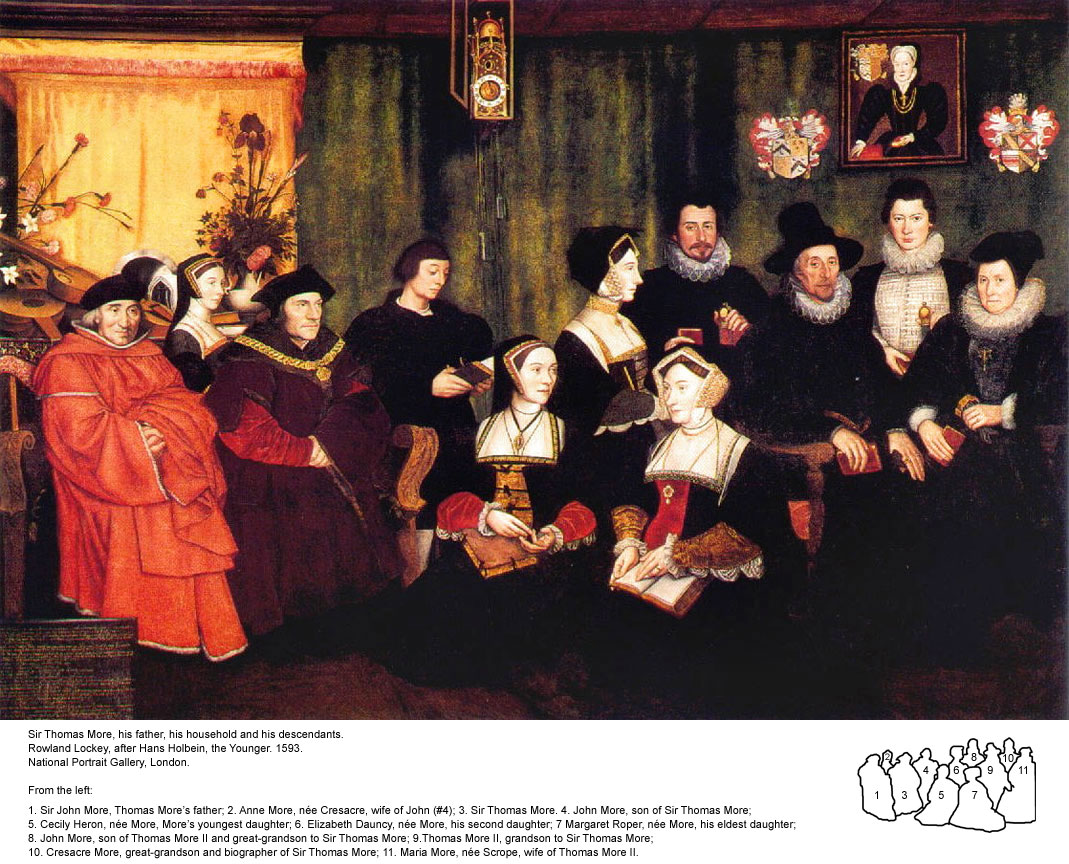
Our youngest son, William Thomas, was named specifically for St. Thomas More.  Shortly before God sent crazy William along , we'd read the novel A Man Born Again by John Edward Beahn (an excellent book we highly recommend) and, finding ourselves the parents of children numbering in the double digits, felt like St. Thomas was just the man we needed on our saintly speed dial.

The father of four children and the counselor and father figure to several others during his life, St. Thomas was the consummate family man, intimately involved in the lives of his children, highly interested in their education, their friendships, and their health, -- physically, mentally, and spiritually.  We're fortunate to have proof of his fatherly concern for his children in the letters he wrote them, and I've never found a better model than this father for saintly, every day parenting ; all through his correspondences -- clearly on  the surface and in between the lines of his practical advice on every day matters, St. Thomas shares his love of God, his love of his Faith, and the priority he holds them.

As most Catholics know the story goes, Thomas More backed up his words and advice to others with action.  He didn't just talk the talk; he was one of the few who get the chance to really walk the walk.  Many of us have played out the scenario in our minds...  Seriously what would we do if we do if we really had to choose between our Faith and the status quot?  What if we had to choose between our Faith and our lives?

  Thomas, a respected employee of the "government" of the king of England in the 16th century (he was named Lord Chancellor of England in 1529) was forced to make that choice -- and he was horrified that he had to.  He was not one to run to the embrace of the executioner.  He had a family he loved that he didn't want to leave and, hoping it might be possible to circumvent the the madness of King Henry's obsessions, he tried to find a loophole out of the whole business.  But it was not to be.  When required by King Henry VIII to sign allegiance to him over the pope, accepting Henry's newly formed Church of England, St. Thomas, against the pleadings of his loving family, refused -- and refused; and refused -- and ultimately lost his life rather than give up his Roman Catholic faith.  

And his family was left.  No father to protect them, to support them, to joke and advise and hug them on his return from the castle every evening. It was a sad earthly loss.   But, what an example!  And what a legacy of Thomas More's real love -- of God, of his Faith, and of his family.  There was never anything more important to St. Thomas than eternal salvation -- for himself and for his family.  Everything else was transitory; he taught his children so and sealed his belief with his blood.  His children did not get to live out the rest of their lives in earthly comfort and honor in King Henry VIII's England, but they had a father who was a saint.   You can't beat that.  You really can't.


Celebrating the Day

*  You can find the life story of St. Thomas -- in a nutshell -- here.
*   There are two versions of the life of St. Thomas on film, A Man for All Seasons, of course.  One stars Paul Scofield (1966), the other, Charlton Heston (1988).  (Though we can't help liking Charlton Heston, we prefer the Scofield version, ourselves...)
* It might be appropriate for the day to serve traditional English fare.  Here's a recipe for Roast Beef and Yorkshire Pudding and here's one for Cornish Pasties.  You can find lots of other ideas here.

Prayer of St. Thomas More

Give me the grace, Good Lord
To set the world at naught. To set the mind firmly on You and not to hang upon the words of men's mouths.
To be content to be solitary. Not to long for worldly pleasures. Little by little utterly to cast off the world and rid my mind of all its business.
Not to long to hear of earthly things, but that the hearing of worldly fancies may be displeasing to me.
Gladly to be thinking of God, piteously to call for His help. To lean into the comfort of God. Busily to labor to love Him.
To know my own vileness and wretchedness. To humble myself under the mighty hand of God. To bewail my sins and, for the purging of them, patiently to suffer adversity.
Gladly to bear my purgatory here. To be joyful in tribulations. To walk the narrow way that leads to life.
To have the last thing in remembrance. To have ever before my eyes my death that is ever at hand. To make death no stranger to me. To foresee and consider the everlasting fire of Hell. To pray for pardon before the judge comes.
To have continually in mind the passion that Christ suffered for me. For His benefits unceasingly to give Him thanks.
To buy the time again that I have lost. To abstain from vain conversations. To shun foolish mirth and gladness. To cut off unnecessary recreations.
Of worldly substance, friends, liberty, life and all, to set the loss at naught, for the winning of Christ.
To think my worst enemies my best friends, for the brethren of Joseph could never have done him so much good with their love and favor as they did him with their malice and hatred.
These minds are more to be desired of every man than all the treasures of all the princes and kings, Christian and heathen, were it gathered and laid together all in one heap.
Amen

(Written by St. Thomas when he was imprisoned in the Tower of London)


St.Thomas More wrote the following letter to his daughter Margaret with a charcoal stick. It was written from prison on July 5, 1535, the day before he was executed.

Our Lord bless you, good daughter, and your good husband, and your little boy, and all yours, and all my children, and all my god-children and all our friends. Recommend me when ye may to my good daughter Cecily, whom I beseech Our Lord to comfort; and I send her my blessing and to all her children, and pray her to pray for me. I send her a handkercher, and God comfort my good son, her husband. My good daughter Daunce hath the picture in parchment that you delivered me from my Lady Coniers, her name on the back. Show her that I heartily pray her that you may send it in my name to her again, for a token from me to pray for me.
I like special well Dorothy Colly. I pray you be good unto her. I would wot whether this be she that you wrote me of. If not, yet I pray you be good to the other as you may in her affliction, and to my good daughter Jane Aleyn too. Give her, I pray you, some kind answer, for she sued hitherto me this day to pray you be good to her.
I cumber you, good Margaret, much, but I would be sorry if it should be any longer than to-morrow, for it is St. Thomas's even, and the utas of St. Peter; and therefore, to-morrow long I to go to God. It were a day very meet and convenient for me.
I never liked your manner towards me better than when you kissed me last; for I love when daughterly love and dear charity hath no leisure to look to worldly courtesy. Farewell, my dear child, and pray for me, and I shall for you and all your friends, that we may merrily meet in heaven. I thank you for your great cost. I send now my good daughter Clement her algorism stone, and I send her and my godson and all hers God's blessing and mine. I pray you at time convenient recommend me to my good son John More. I liked well his natural fashion. Our Lord bless him and his good wife, my loving daughter, to whom I pray him to be good, as he hath great cause; and that, if the land of mine come to his hands, he break not my will concerning his sister Daunce. And the Lord bless Thomas and Austin, and all that they shall have.


St. Thomas More, help us, by your holy example and your prayers, to save our own souls and lead
 our children also to heaven!


*Repost from 2012

Thursday, May 22, 2014

St. Rita of Cascia

For a long time this statue of St. Rita stood near my laundry area, an appropriate place, I thought, because she's the Saint of the Impossible. But, she's also a saint whose story it's good to remember if I'm tempted to bemoan my lot in life. You see, though she was highly favored spiritually, Rita's physical world was about as bad as it could get. Next to the problems she encountered in her married life, I have nothing to complain about.

St. Rita was born to pious parents in the village of Roccaporena near Cascia, Italy, in 1381. At an early age, she felt called to the religious life, but in obedience to her parents, married a man named Paolo Mancini; twin boys were shortly born to them. Because of the political nature of her husband's profession, Rita's homelife was filled with stress and worry for her husband, and some sources say that this same stress led Paolo to be a neglectful and abusive husband at first, but Rita, with love, prayers, and patience, turned his heart and saved his soul. Unfortunately, though, when their children were young men, Paolo was murdered by one of political enemies, and the twins, led by the Italian notion of vendetta, sought payback. Their mother, fearing for her sons' souls more than their lives, prayed in earnest that they would be turned from their plan, and her prayers were heard, but not in the way most of us would prefer; both sons died of natural causes before they could take action, ending their lives in the state of grace, forgiving their enemies. A hard solution, but one that their mother accepted gratefully.

But Rita was now alone in the world. She turned to the vocation denied her in her early life, and sought admission to the convent of the Augustinian Nuns of Saint Mary Magdalene, but she was denied. So, of course, she resorted to prayer, asking particularly the assistance of her three special patrons, St. John the Baptist, St. Augustine, and St. Nicholas of Tolentino. The story goes that after prayer, she felt called to request admission again, but, arriving at the convent, found the gates locked. The will of God, however, finds no obstacle in a locked gate, and St. Rita, miraculously appearing inside the gates, applied for admission once more and was welcomed into the Order.

She lived out her life as an Augustinian nun, following her vocation with the Nuns of St. Mary Magdalene for forty years. When she was about sixty years old, she was favored with the stigmata, a thorn in her forehead, a wound which caused her extreme pain, but which she bore with grace and patience for love of Christ and the good of souls.


St. Rita died on May 22nd, 1457. She is an incorruptible, and, as well as being the patron saint of Impossible Cases, she is the patroness of sickness, wounds, marital problems, abuse, and mothers.

** You can go here for a beautiful and inspiring blog dedicated entirely to St. Rita of Cascia!

** There is a Novena to St. Rita here.

***  This is a repost from 2009...

Monday, April 28, 2014

The Feast of St. Mark

What do you know about St. Mark?  Even though, Mark is my husband's middle name, and therefore, one of his patrons, until I did some research this afternoon, I knew very little.  Even though St. Mark is one of the four Evangelists, he seems somehow to hide in the shadows of the Bible.  He's just a little bit anonymous, in other words:  he's not like St. Matthew, unversally known for being the Jewish tax collector; he's not St. Luke, the physican, who learned the tales of the Bible through the lips of the Mother of God; he's not St. John, the beloved Apostle, who survived being boiled in oil...  So who is St. Mark?


Abbot Gueranger says in the Liturgical Year:

Mark was the beloved disciple of Peter; he was the brilliant satellite of the sun of the Church.  He wrote his Gospel at Rome, under the eyes of the Prince of the Apostles.  The Church was already in possession of the history given by Matthew; but the faithful of Rome whished their own Apostle to narrate what he had witnessed.  Peter refused to write it himself, but he bade his disciple take up his pen, and the Holy Ghost guided the hand of the new Evangelist.

Yes.  But what do we know about the man?

After looking around (and around and around), I've found that we do have one or two facts -- and a lot of guessing -- about St. Mark.  He was believed to have been born in Jerusalem and was the cousin of Barnabus, the disciple of St. Paul.  He is reported to have been a Jewish priest and a learned man,  and it is traditionally believed that he was a married man when he became a Christian.  St. Mark's mother,  (another) Mary, seems to have been one of the faithful women of the early Church; it was to her home that St. Peter apparently fled after his release from prison (Acts 12:12-13). 

  We don't really know for sure, but there are many traditions explaining how St. Mark entered into the service of the Apostles. Of course it could have been through the instigation of his mother that he became a Christian and met the Apostles, but there are other ideas floating around out there, as well. One account supposes that it may have been Mark who carried water to Jesus and the Twelve at the Last Supper and there is speculation that Mark was one of the servants at the Marriage at Cana who poured out the water that Jesus turned to wine (John 2:1-11).  In addition to these conjectures, it is thought that St. Mark was referring to himself when he told about the young man who ran away naked when Jesus was arrested (Mark 14:51-52), and the Coptic Church believes it was St. Mark who hid the disciples in his house after the crucifixion, into whose house Jesus came after the Resurrection (John 20), and into whose house the disciples received the Holy Ghost at Pentecost -- and that Mark may have been one of the Seventy Apostles sent out by Jesus (Luke 10:1).  But all of this is speculation.  What we do know for sure is that St. Mark, though not counted as one of the twelve Apostles, became a trusted ally and helper of the first pope, so trusted that St. Peter gave him the job of writing his account of the life of Christ.

But St. Mark did more than just write.  After the Gospel was finished,  St. Peter continued to make good use of his faithful friend, sending him to Aquileia (an ancient Roman city at the head of the Adriatic Sea), then to Egypt -- namely Alexandria -- and Antioch.  In Alexandria, St. Mark  founded one of the first Christian schools and instituted what has been called the first seed of monastic life in his Therapeutes.  It was in Alexandria that the success of St. Mark's preaching resulted in his martyrdom. He was dragged to his death by a rope tied around his neck in the year 68 AD, after some thirty-five years laboring for the Church. 

The Greater Litanies Procession is also on this day. 

Here is the post from last year about this traditional recitation of these powerful intercessory prayers.  And here are pictures of the blessing of the farm, along with the text of some of the traditional blessing prayers.
(Tho I looked almost everywhere in cyberspace, all info here was gleaned from The Catholic Encyclopedia and The Liturgical Year, with a couple of the speculations about his meeting the Apostles gleaned from Wikipedia and a Coptic Church site.  Oh, and the drawing above is "The Head of St. Mark" by Albrecht Durer )

For my husband, from St. Mark, on his Name Day, four days before our 27th anniversary. :)


** Repost from 2010.

Friday, January 31, 2014

Feast Day of the Apostle of Youth

January 31st


"Enjoy yourself as much as you like – if only you keep from sin."

~ St. John Bosco

One of the mottos of our life -- especially since we've raised teenagers, these words of Don Bosco's are simple to understand, but, boy, they can be difficult sometimes for a young person to carry out! St. John Bosco knew the problem well, caring for the bodies and souls of  scores of boys and girls in Italy in the late nineteenth century, and parents today know the same challenge.   It doesn't matter when in history a child lives, life can be full of confusion and trouble -- especially when the child is trying to find his footing on the way into adult life.  In Don Bosco's day, just as in ours, enjoying one's self while not sinning could be a trick to pull off.   Going out to have fun with friends very often carried the temptation to walk the tightrope of morality  in the best case -- and to jump right off, in the worst.

And it is tough out there to "keep your nose clean," especially in the teen years -- when everything's in turmoil, anyway. But, as if that weren't enough, our children today are bombarded with assaults to their purity, their integrity, and their faith at every turn. There's practically no escaping it!  It's too easy for the best of kids to give into pressure and believe that enjoyment means fun that is "adult" or illicit. In their hurry to grow up in a world that forces adult themes on them from day one, it can be easy for young people to forget the simple pleasure of wholesome fun.

I guess most of us here in the choir probably see the problem.  But what can we do?

Here are some thoughts -- stream-of-consciousness style:

(Do please feel free to skip this meandering if you like! It's long!)

Stress wholesome fun!  This is easy.  Just play! * Start with rolling the babies  a ball, end with pitching it to them. * Teach your toddlers to roll the ball to one another. * Teach one to praise the other when they catch it.  Never forget what a joy your babies and toddlers are!  (They grow up so fast!) * Make dimples in your cheeks more than you creases in your forehead.  * Praise one another behind each other's back.  * Never criticize behind another's back.  * Correct, when necessary, gently and in privacy.  * Choose your children's friends wisely and exclusively for as long as you can. * Be ruthless about it.  * Teach them to discriminate friendships safe and unsafe for their souls so that when they can choose for themselves, they'll do so wisely.  * Make up softball (or football or volleyball) teams with parish families and make sure to play together after Mass every Sunday possible. ( This is far more valuable for children's far-reaching growth and development than any "organized" sport you will ever enroll them in.) *  Never take for granted what a joy your single-digit children are! (They grow up so fast!) * Play card and board games as a family. * At the drop of a hat. * Often.  * Turn off the TV.   * Laugh. * Laugh as often as you can.  * But never tease. * See good wholesome movies. * Screen them ahead of time (Google them!) for content and make a big deal out of seeing them together and with friends. * Explain why these movies are good movies. * Explain why you don't see other movies.  * Be a good example; don't see a movie you wouldn't want your children seeing.  * If in doubt, don't go see a movie (or play, or concert) you wouldn't invite the Blessed Mother to attend.  * Enjoy every moment with your adolescents and young teens! (They grow up so fast!) * Read good, wholesome books. * Tell your children about them.  * Read out loud.  * Every day. * Recommend good books to everyone in the family.  * Explain why they're good books. * Explain why others are not. * Tell the story of your life. * Detail your best moments * Include your embarassing moments. * Laugh at the silly stuff!  * Explain your mistakes. * Tell what you should have done differently and why. * Listen to your children's stories. * Ask them about their day.  * Even if you've spent the whole day with them!  * Apologize when you're wrong  * Spend one-on-one time with each child (and your spouse!)  as often as you can. * Even if it's just while you load the dishwasher. * Sing. * Sing a lot. * Loudly. *  Even if it's badly. * Spend every moment you can with your teens and young adults!  (They grow up so fast!)  * Praise good behaviour; never qualify bad behaviour as anything other than bad, but discuss it always in relationship to Our Lord's Sacred heart.  *Talk about God. * In everything you do.  * Be on a first-name basis with the saints.  * Include them in all the good stuff, not just the trouble!  * Blend the Church calendar in with all the other calendars that are important to your family.  * But make God's appointments always take precedence.  * Be sure your children know it is an occasion to be sad for others when they pressure you to put God second (or third, or worse), and never never give in.  * Introduce Mary as a second mother; love her tenderly; depend upon her. * Pray.  * Smile and even laugh when you pray. * Pray alone. * Pray in pairs when you go out walking.  * Pray in groups altogether. * Pray in the morning.  * Pray at night. * Never miss the family rosary.  * Pray when you get in the car.  * Pray when you arrive home safely.  * Bless heaven and earth with smiles and laughter.  * Enjoy every minute of it.  * As much as you like.  * Only keep from sinning.


We're still in the trenches here at our house, in this business of child-raising  -- and I guess we will be until the day we die.  We've found out that parenthood most definitely doesn't end when the children move out of the house!  Out of our ten, we have four sons and one daughter officially "on their own" now and have been parenting for twenty-five years.  And we're still learning; make no mistake!   Each child and each passing year brings its own challenges and lessons.  We don't have it all figured out and never will.

But we have learned a couple things: 1) We can never, ever rest on our laurels; the devil would like nothing better and the world is a tough competitor for our children's hearts and souls.  We have to keep vigilant, keep studying, keep praying.   And, 2) We must always call on our heavenly patrons for their invaluable help. By prayer, and when possible, by reading their words of advice. There is little we've learned about raising children (especially teenage boys), for example,  that we haven't gleaned from St. John Bosco and the Salesian method.  Anything we might have thought we figured out ourselves, we later learned was a teaching of the good Salesian Fathers. You have to know, then, that it's with great caution that I suggest anyone follow any of our examples, but with the greatest confidence I recommend you to the writings of Don Bosco and his the traditional method of his Order.  It's for good reason that our saint is called the patron of youth; his influence with them was great on earth -- and is still great today from heaven.

Good Don Bosco,  Pray For Us!


Prayer to Saint John Bosco

O glorious Saint John Bosco, who, in order to lead young people to the feet of the divine Master and to form them in the light of faith and Christian morality, didst heroically sacrifice thyself to the very end of thy life and didst found a fitting religious Institute destined to endure and to bring to the farthest boundaries of the earth thy glorious work, obtain also for us from our Lord a holy love for young people, who are exposed to so many seductions, in order that we may generously spend ourselves in supporting them against the snares of the devil, in keeping them safe from the dangers of the world, and in guiding them, pure and holy, in the path that leads to God. Amen

(Indulgence of 300 days)

Prayer of St. John Bosco to the Blessed Virgin Mary

O Mary, powerful Virgin, thou art the mighty and glorious protector of holy Church; thou art the marvelous help of Christians; thou art terrible as an army in battle array; thou alone hast destroyed every heresy in the whole world. In the midst of our anguish, our struggles and our distress defend us from the power of the enemy and at the hour of our death receive our souls in paradise. Amen.

(Indulgence of 3 years)


Books for children:
Stories of Don Bosco
St. John Bosco and St. Dominic Savio (Vision Book)

For us older folks:
Forty Dreams of St. John Bosco: The Apostle of  Youth
Biography: St. John Bosco (F.A. Forbes)
Several pamphlets about the Salesian method and Don Bosco can be found here, as well.

Some former posts with more ideas for today's feast day, plus links, here.

* This is a repost from a couple of years ago -- with a couple of small updates to reflect our growing and "moving out and up" children.

Wednesday, January 29, 2014

Feast of St. Francis de Sales


January 29th


Born:1567 :: Died:1622


St Francis de Sales is another one of my favorite saints. (How many does that make now?) Another of the saints from big families, St. Francis was the oldest of six brothers!  It's hard not to love his gentle, nature-filled lessons and practical kind wisdom.  But as gentle and kind as he always seems in his letters and sermons, I've read that he started out life with a choleric disposition, impatient and inclined toward anger. You'd never know, though. That he could reform so completely, by the grace of God and much perserverence, gives me hope!  He's also well known for his eloquent and inspired writings, as well as a large volume of beautifully encouraging correspondences with the faithful.  If you haven't read any De Sales, I highly recommend him!


Here is an online reprint of St. Francis' Treatise on the Love of God .

St. Francis' Introduction to the Devout Life  can be read online here.

St. Francis de Sales is the Patron Saint of:

Authors
Deafness
Journalists
Writers

Prayer of St. Francis
(from the Treatise on the Love of God, Bk 10)
 
Lord, I am yours,
and I must belong to no one but you.
My soul is yours,
and must live only by you.
My will is yours,
and must love only for you.
I must love you as my first cause,
since I am from you.
I must love you as my end and rest,
since I am for you.
I must love you more than my own being,
since my being subsists by you.
I must love you more than myself,
since I am all yours and all in you.
Amen.

Here is my particular prayer to our patron of the day:

Dear St. Francis de Sales, patron of communicators, pray for all of us who navigate the modern world through the internet. Help us to use it as a source of edification and a means of communicating to others only what is pleasing to God. Amen.
 
 Quotes from St. Francis de Sales:


"Nothing is so strong as gentleness, nothing so gentle as real strength."
 
“Do not wish to be anything but what you are, and try to be that perfectly
 
“Do not lose courage in considering your own imperfections.”


“Never be in a hurry; do everything quietly and in a calm spirit. Do not lose your inner peace for anything whatsoever, even if your whole world seems upset.”
 
“Have patience with all things, but chiefly have patience with yourself.”


“If the heart wanders or is distracted, bring it back to the point quite gently and replace it tenderly in its Master's presence. And even if you did nothing during the whole of your hour but bring your heart back and place it again in Our Lord's presence, though it went away every time you brought it back, your hour would be very well employed.”
 
“Reputation is rarely proportioned to virtue.”
 
“While I am busy with little things, I am not required to do greater things.”


“Have patience to walk with short steps until you have wings to fly.”
 
"If we say a little it is easy to add, but having said too much it is hard to withdraw and never can it be done so quickly as to hinder the harm of our success. "
 
"When you encounter difficulties and contradictions, do not try to break them, but bend them with gentleness and time."


"When the bee has gathered the dew of heaven and the earth's sweetest nectar from the flowers, it turns it into honey, then hastens to its hive. In the same way, the priest, having taken from the altar the Son of God (who is as the dew from heaven, and true son of Mary, flower of our humanity), gives him to you as delicious food."
 
"Always be as gentle as you can, and remember that more flies are caught with a spoonful of honey than with a hundred barrels of vinegar."

To Celebrate the Feast

Due largely to these last two quotes of St. Francis, his tendency to use analogies from nature, and the golden sweetness and purity of his counsel, it seems only right and good to celebrate his feast day by cooking with honey!

To that end, Catholic Cuisine offers a honey breakfast bar recipe to celebrate this feast, and here is one of many sites which lists many recipes using honey.  One of our favorite honey-based recipes is our homemade granola.  Here's our recipe:

1 box (6 cups) rolled oats
1 cup chopped nuts (we like almonds)
1 cup wheat germ
1/2 teaspoon cinnamon
1/4 teaspoon salt
3/4 cup honey (or honey mixed with maple syrup)
1/3 cup oil, any kind, but we like safflower oil
1 teaspoon vanilla
1/2 - 1 cup raisins
1/2 - 1 cup chopped dates

Preheat the oven to 300 degrees. Combine the first 5 ingredients. Warm the honey, add the oil and vanilla. Drizzle the honey-oil over the dry ingredients and toss to coat. Spread the mixture onto 2 cookie sheets. Bake about 30 minutes until golden, stirring every 10 minutes.

When done, remove from oven and stir in dried fruit if used. As the granola cools, it will lose its stickiness and become crunchy. Makes about 9 cups. Store in airtight containers.  Be amazed if it lasts 2 breakfast-times.

Click, copy, and print for a coloring page.

You can also find a lovely coloring page here, at Catholic Playground.

* Did this post look familiar?  :)  It's a repost from last year -- and the year before... But every year I add a little something.