Showing posts with label Saints From/With Large Families List. Show all posts

Sunday, July 6, 2014

The Feast of St. Thomas More


Happy Nameday, William Thomas!
Our youngest son, William Thomas, was named specifically for St. Thomas More.  Shortly before God sent crazy William along , we'd read the novel A Man Born Again by John Edward Beahn (an excellent book we highly recommend) and, finding ourselves the parents of children numbering in the double digits, felt like St. Thomas was just the man we needed on our saintly speed dial.

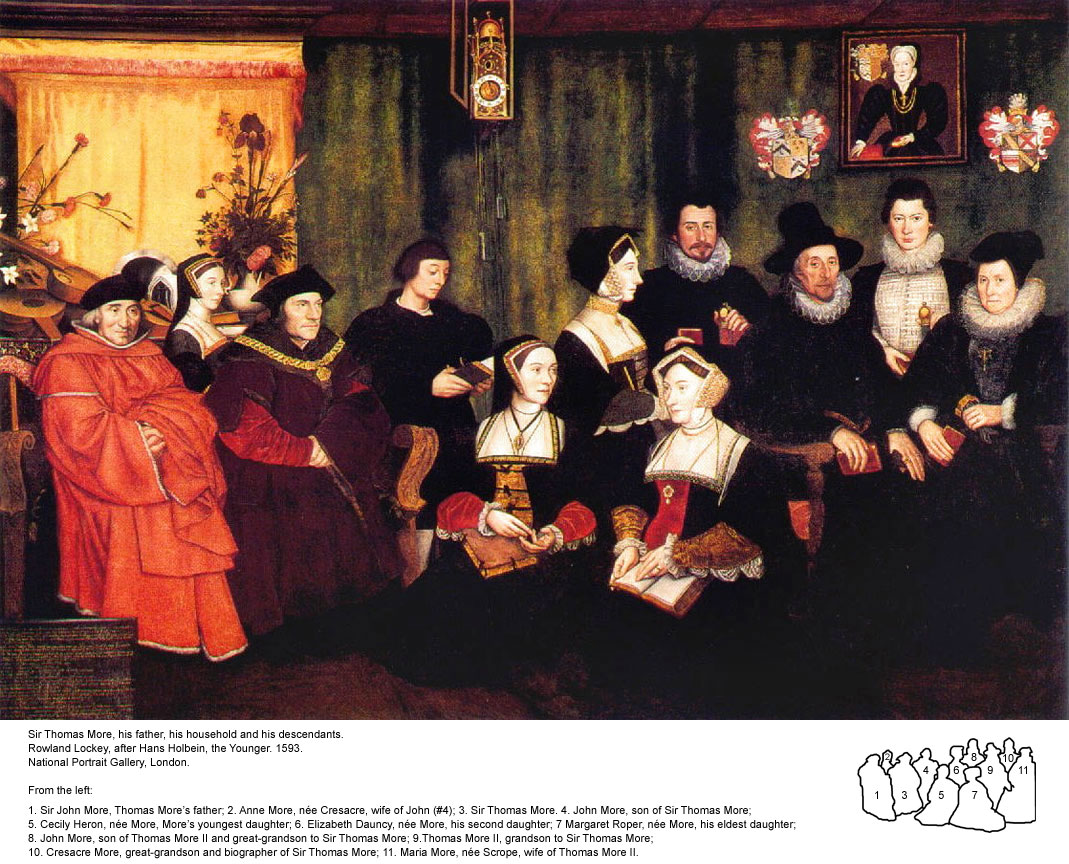
The father of four children and the counselor and father figure to several others during his life, St. Thomas was the consummate family man, intimately involved in the lives of his children, highly interested in their education, their friendships, and their health, -- physically, mentally, and spiritually.  We're fortunate to have proof of his fatherly concern for his children in the letters he wrote them, and I've never found a better model than this father for saintly, every day parenting ; all through his correspondences -- clearly on  the surface and in between the lines of his practical advice on every day matters, St. Thomas shares his love of God, his love of his Faith, and the priority he holds them.

As most Catholics know the story goes, Thomas More backed up his words and advice to others with action.  He didn't just talk the talk; he was one of the few who get the chance to really walk the walk.  Many of us have played out the scenario in our minds...  Seriously what would we do if we do if we really had to choose between our Faith and the status quot?  What if we had to choose between our Faith and our lives?

  Thomas, a respected employee of the "government" of the king of England in the 16th century (he was named Lord Chancellor of England in 1529) was forced to make that choice -- and he was horrified that he had to.  He was not one to run to the embrace of the executioner.  He had a family he loved that he didn't want to leave and, hoping it might be possible to circumvent the the madness of King Henry's obsessions, he tried to find a loophole out of the whole business.  But it was not to be.  When required by King Henry VIII to sign allegiance to him over the pope, accepting Henry's newly formed Church of England, St. Thomas, against the pleadings of his loving family, refused -- and refused; and refused -- and ultimately lost his life rather than give up his Roman Catholic faith.  

And his family was left.  No father to protect them, to support them, to joke and advise and hug them on his return from the castle every evening. It was a sad earthly loss.   But, what an example!  And what a legacy of Thomas More's real love -- of God, of his Faith, and of his family.  There was never anything more important to St. Thomas than eternal salvation -- for himself and for his family.  Everything else was transitory; he taught his children so and sealed his belief with his blood.  His children did not get to live out the rest of their lives in earthly comfort and honor in King Henry VIII's England, but they had a father who was a saint.   You can't beat that.  You really can't.

Celebrating the Day

*  You can find the life story of St. Thomas -- in a nutshell -- here.
*   There are two versions of the life of St. Thomas on film, A Man for All Seasons, of course.  One stars Paul Scofield (1966), the other, Charlton Heston (1988).  (Though we can't help liking Charlton Heston, we prefer the Scofield version, ourselves...)
* It might be appropriate for the day to serve traditional English fare.  Here's a recipe for Roast Beef and Yorkshire Pudding and here's one for Cornish Pasties.  You can find lots of other ideas here.

Prayer of St. Thomas More

Give me the grace, Good Lord
To set the world at naught. To set the mind firmly on You and not to hang upon the words of men's mouths.
To be content to be solitary. Not to long for worldly pleasures. Little by little utterly to cast off the world and rid my mind of all its business.
Not to long to hear of earthly things, but that the hearing of worldly fancies may be displeasing to me.
Gladly to be thinking of God, piteously to call for His help. To lean into the comfort of God. Busily to labor to love Him.
To know my own vileness and wretchedness. To humble myself under the mighty hand of God. To bewail my sins and, for the purging of them, patiently to suffer adversity.
Gladly to bear my purgatory here. To be joyful in tribulations. To walk the narrow way that leads to life.
To have the last thing in remembrance. To have ever before my eyes my death that is ever at hand. To make death no stranger to me. To foresee and consider the everlasting fire of Hell. To pray for pardon before the judge comes.
To have continually in mind the passion that Christ suffered for me. For His benefits unceasingly to give Him thanks.
To buy the time again that I have lost. To abstain from vain conversations. To shun foolish mirth and gladness. To cut off unnecessary recreations.
Of worldly substance, friends, liberty, life and all, to set the loss at naught, for the winning of Christ.
To think my worst enemies my best friends, for the brethren of Joseph could never have done him so much good with their love and favor as they did him with their malice and hatred.
These minds are more to be desired of every man than all the treasures of all the princes and kings, Christian and heathen, were it gathered and laid together all in one heap.
Amen

(Written by St. Thomas when he was imprisoned in the Tower of London)


St.Thomas More wrote the following letter to his daughter Margaret with a charcoal stick. It was written from prison on July 5, 1535, the day before he was executed.

Our Lord bless you, good daughter, and your good husband, and your little boy, and all yours, and all my children, and all my god-children and all our friends. Recommend me when ye may to my good daughter Cecily, whom I beseech Our Lord to comfort; and I send her my blessing and to all her children, and pray her to pray for me. I send her a handkercher, and God comfort my good son, her husband. My good daughter Daunce hath the picture in parchment that you delivered me from my Lady Coniers, her name on the back. Show her that I heartily pray her that you may send it in my name to her again, for a token from me to pray for me.
I like special well Dorothy Colly. I pray you be good unto her. I would wot whether this be she that you wrote me of. If not, yet I pray you be good to the other as you may in her affliction, and to my good daughter Jane Aleyn too. Give her, I pray you, some kind answer, for she sued hitherto me this day to pray you be good to her.
I cumber you, good Margaret, much, but I would be sorry if it should be any longer than to-morrow, for it is St. Thomas's even, and the utas of St. Peter; and therefore, to-morrow long I to go to God. It were a day very meet and convenient for me.
I never liked your manner towards me better than when you kissed me last; for I love when daughterly love and dear charity hath no leisure to look to worldly courtesy. Farewell, my dear child, and pray for me, and I shall for you and all your friends, that we may merrily meet in heaven. I thank you for your great cost. I send now my good daughter Clement her algorism stone, and I send her and my godson and all hers God's blessing and mine. I pray you at time convenient recommend me to my good son John More. I liked well his natural fashion. Our Lord bless him and his good wife, my loving daughter, to whom I pray him to be good, as he hath great cause; and that, if the land of mine come to his hands, he break not my will concerning his sister Daunce. And the Lord bless Thomas and Austin, and all that they shall have.


St. Thomas More, help us, by your holy example and your prayers, to save our own souls and lead
 our children also to heaven!


*Repost from 2012

Wednesday, July 6, 2011

St. Thomas More, Patron of Large Families

The Biography of St. Thomas  in the Catholic Encyclopedia

His story in a nutshell: St. Thomas More, the father of four children (plus the daughter of his second wife whom he adopted) and a highly respected lawyer and chancellor of England in the early 16th century, was imprisoned in the Tower of London and later martyred for his refusal to bend his religious beliefs for the pleasure of King Henry VIII.

Basic Stats:

Born
•7 February 1478 at London, England

Married
* 1505 Jane Colte, who bore their four children (three girls and a boy) before dying in 1511

Died
•beheaded on 6 July 1535 on Tower Hill, London, England
•body taken to Saint Peter ad Vincula, Tower of London, England
•his head was parboiled and then exposed on London Bridge for a month as a warning to other “traitors”; Margaret Roper bribed the man whose was supposed to throw it into the river to give it to her instead
•in 1824 a lead box was found in the Roper vault at Saint Dunstan’s Church Canterbury, England; it contained a head presumed to be More’s

Beatified
•1886 by Pope Leo XIII

Canonized
•1935 by Pope Pius XI

Patronage
•adopted children
•Arlington, Virginia, diocese of
•Ateneo de Manila Law School
•civil servants
•court clerks
•difficult marriages
•large families
•lawyers
•Pensacola-Tallahassee, Florida, diocese of
•politicians (2000 by Pope John Paul II)
•politicos (2000 by Pope John Paul II)
•statesmen (2000 by Pope John Paul II)
•step-parents
•University of Malta
•University of Santo Tomas Faculty of Arts and Letters
•widowers

To celebrate the feast day, A Man For All Seasons (1966, starring Paul Scofield) provides an excellent portrait of St. Thomas' life.  It can be found on Netflix!


Writings and Quotes of Saint Thomas More
Treatise on the Blessed Sacrament
Utopia
 
"You must not abandon the ship in a storm because you cannot control the winds... What you cannot turn to good, you must at least make as little bad as you can."
 
From Utopia, 1516:
"Nothing can come except what God wills. And I make me very sure that whatsoever that be, even if nothing has ever appeared so bad, it shall indeed be the best... I never intend, God being my good Lord, to pin my soul to another man's back, not even the best man that I know this day living; for I know not where he may hap to carry it."

To his daughter, from prison 1534:
"What men call fame is, after all, but a very windy thing. A man thinks that many are praising him, and talking of him alone, and yet they spend but a very small part of the day thinking of him, being occupied with things of their own."

"I will not mistrust [God], though I shall feel myself weakening and on the verge of being overcome with fear... I trust he shall place his holy hand on me and in the stormy seas hold me up from drowning."

"If any man marvel that God made all His creatures such as they should always need aid of His grace, let him know that God did it out of His double goodness. First, to keep them from pride by causing them to perceive their feebleness, and to call upon Him; and secondly to do His creatures honor and comfort."
"Often, actually very often, God allows his greatest servants to make the most humiliating mistakes."
"A man buys hell here with so much pain, that he might have heaven with less than one-half. Occupy your minds with good thoughts, or the enemy will fill them with bad ones. Unoccupied, they cannot be."
"If I am distracted, Holy Communion helps me to become recollected. If opportunities are offered by each day to offend my God, I arm myself anew each day for the combat by the reception of the Eucharist. If I am in special need of light and prudence in order to discharge my burdensome duties, I draw nigh to my Saviour and seek counsel and light from him."

"The ordinary acts we practice every day at home are of more importance to the soul than their simplicity might suggest."

Erasmus' written portrait of St. Thomas More, written in July of 1519:
 
To begin then with what is least known to you, in stature he is not tall, though not remarkably short. His limbs are formed with such perfect symmetry as to leave nothing to be desired. His complexion is white, his face rather than pale and though by no means ruddy, a faint flush of pink appears beneath the whiteness of his skin. His hair is dark brown or brownish black. The eyes are grayish blue, with some spots, a kind which betokens singular talent, and among the English is considered attractive, whereas Germans generally prefer black. It is said that none are so free of vice. His countenance is in harmony with his character, being always expressive of an amiable joyousness, and even an incipient laughter and, to speak candidly, it is better framed for gladness than for gravity or dignity, though without any approach to folly or buffoonery. The right shoulder is a little higher than the left, especially when he walks. This is not a defect of birth, but the result of habit such as we often contract. In the rest of his person there is nothing to offend . . .He seems born and framed for friendship, and is a most faithful and enduring friend . . .When he finds any sincere and according to his heart, he so delights in their society and conversation as to place in it the principal charm of life . . .In a word, if you want a perfect model of friendship, you will find it in no one better than in More . . .In human affairs there is nothing from which he does not extract enjoyment, even from things that are most serious. If he converses with the learned and judicious, he delights in their talent, if with the ignorant and foolish, he enjoys their stupidity. He is not even offended by professional jesters. With a wonderful dexterity he accommodates himself to every disposition. As a rule, in talking with women, even with his own wife, he is full of jokes and banter. No one is less led by the opinions of the crowd, yet no one departs less from common sense . . .


 Prayer of St. Thomas More
Give me the grace good Lord,
to set the world at naught;
to set my mind fast upon Thee
and not to hang upon the blast of men's mouths.
To be content to be solitary.
Not to long for worldly company
but utterly to cast off the world
and rid my mind the business thereof.
Not to long to hear of any worldly things,
But that the hearing of worldly phantasies may be to me displeasant.
Gladly to be thinking of God,
Piteously to call for His help,
To lean unto the comfort of God,
Busily to labor to love Him.
To know mine own vility and wretchedness,
To humble and meeken myself under the mighty hand of God,
To bewail my sins passed;
For the purging of them, patiently to suffer adversity.
Gladly to bear my purgatory here,
To be joyful of tribulations,
To walk the narrow way the leadeth to life.
To bear the cross with Christ,
To have the last thing--death--in remembrance,
To have ever afore mine eye my death, that is ever at hand;
To make death no stranger to me;
To foresee and consider the everlasting fire of hell;
To pray for pardon before the Judge come.
To have continually in mind the passion that Christ suffered for me;
For His benefits uncessantly to give Him thanks,
To but the time again that I before have lost.
To abstain from vain confabulations,
To eschew light foolish mirth and gladness;
Recreations not necessary, to cut off.
Of worldly substance, friends, liberty, life and all--to set the loss at nought
for the winning of Christ.
To think my most enemies my best friends,
For the brethren of Joseph could never have done him so much good
with their love and favor as they did him with their
malice and hatred.
- Saint Thomas More

Check out:
St. Thomas More Pro Life Law Center
St Thomas More: Model For Modern Catholics by John F. Fink