Thursday, August 7, 2014

31 Days of Fun: 7th Day -- Making Faces

Bought a package of face paints and  gave them to the children this afternoon with instructions to kindly keep the paint on their faces -- and not their clothes, or the walls, or  the furniture..

Here's what they came up with:


Gabe:  Didn't let the paint near him.  Wanted no part of it.  Had better things to do.


.
William:  Seeing the bunny face on the cover of the face paint ideas book, he only agreed to let Theresa paint something,if it was indisputably "he-man."


Anna:  Everyone really wanted William to be a mime (I mean BE a mime), but he wouldn't do it.  So Anna did.


Theresa: The artist of everyone else's face, Theresa had Cathy paint her as Princes Amidala (Star Wars)


Cathy:  Her choice took the longest to paint and was, by far, the creepiest. 

Oh my goodness, Catherine!

A palate cleansing photo may be in order now.
Cathy as her usual self; she cleans up pretty well.

And, now... Last but not least: what Gabriel accomplished while his sisters wasted their afternoon painting their faces.  (Ugh.  Girls!)


This little wagon, made out of two empty cans, two skewers, a grocery store box, some duct tape, and a bit of rope will help Gabe bring the mail home from the post box if there's too much too carry.  He spent his afternoon making something useful out of recycled materials.  While his sisters...  well... It's just too embarassing to...  um...  try to explain.  Seriously. Girls!  What are you going to do about them?

Wednesday, August 6, 2014

31 Days of Fun: Day 6 -- Just Behaving Ourselves


 Incentives to be Good Little Children

For Lent, well-behaved children got to add hearts to fill up the Sacred Heart of Jesus drawn on our white board.
Yeah...  Sorry.  The photo is a little crooked.

For the month of August, they get to draw flowers in the Immaculate Heart!

Gabey getting to add a flower...
* Some ideas for getting through a long hot August, keeping the children happy, and Mom sane -- post following here.

Helping Children Behave During Long, Boring, Hot August

One thing all parents know:  Boredom + Being Together Too Much = Bickering.

 No question about it, where two or more people (no matter how old they are) are stuck together in one place for too long -- with nothing to do -- there will be dissent and quarreling, whining and complaining, hate and discontent.  No kidding, summertime at home with all the children can be a challenge for Mom. It's a pity we can't just be gone away from home on holiday through the whole summer break, where everyone is happily distracted and having too much fun to be ornery. But there's a whole lot of time left to fill between holiday trips and outings -- and it's awkward time, when our ordinary-life routines are turned upside-down, children are thrown together who may not be used to seeing each other all day every day, and a lack of structure leaves everyone at loose ends, ready for bad moods.  By August, all summer novelty has worn off and the whole crew is ready to mutiny.
 
What's a mom to do?

Here's my answer:   DELEGATE!

Though a certain amount of planning on your part is important, don't fool yourself into thinking it's all up to you to keep everyone happy all summer long.  Unless your children are all still toddlers and infants (in which case this is a season of your life when you really do spend most of your time entertaining and caring for them), you can and should leave a good amount of their free time up to your children to organize.  You'll need to start them out with some rules and basic planning, but if you have children over the age of reason, the best summers are ones that they create for themselves!

Here are some things you can do to help them hold boredom at bay, keep their minds and bodies active, and make fun out of the long days of summer -- with a minimum of arguing amongst them:

* Have plenty of resources available for all ages: craft and art supplies, board games, balls, jumpropes, etc
.  Make a space for everything -- and require that they be replaced to that space when no longer in use.  Be clear about who has to replace them and by what time.  If you leave a question, the children won't generally go to the trouble to find out what you expect -- and nothing will be cleaned up.  Or the blame game will start -- and heaven knows, we want to avoid that!

*  Pull out a stack of special summer reading -- either from books you already have, or borrowed from the library.  Maybe even set aside special blocks of time just for reading.  Set the scene for comfort with quiet music everyone likes, comfy pillows, and maybe even clean-finger snacks to nibble on while reading.  Choose special read-alouds for summer.  (*We love Mark Twain for summer reading, as well as pirate classics, like Treasure Island.  We've also enjoyed some of the classic series over summertime,  such as the Narnia tales and the Lord of the Rings.)

* Make a list of ideas for simple activities for the children (and yourself!) to draw from, so no one can say they can't think of something to do! Write several ideas on a white board or chalk board or make a small index card file with ideas -- or queue up a website with summer fun ideas!  Like this one.  Make sure there are an equal number of indoor and outdoor things that they can safely do/play on their own.

* Make rules about television and movie viewing.  Too much of "the tube" makes for cranky kids! Block off the times of day you will allow it and make rules about who gets to choose what to watch, when.  Our general rule is that anyone who gets up before 8 a.m. can watch one of a handful of Netflix shows that have been okayed.  Then, with permission, they're allowed to watch a documentary in the middle of the afternoon when it's hottest outdoors -- and we all watch a movie or program together a few evenings a week, as Mom and Dad decide. (Mythbusters is our favorite, but we also really like the old John Waynes and other classic movies.)

*  Have healthy snacks and drinks available.  Make specific times that the children are allowed to snack.
 Make specific rules about who cleans up, when.  (I know I repeat the "specific rules" thing a lot - but, if you want to avoid arguments and misunderstandings, it's super important to make sure everyone understands what you expect!)

* Make rules about where and when toys may be dragged out to be played with -- and when they need to be put away and by whom.  For instance, we have a craft table that our little boys are permitted to build their elaborate block or Leggo structures on, and they're allowed to leave those toys on that table indefinitely, but they're not allowed to build with them anywhere else in the main living space.(Their bedroom is always free to play in, but has to be cleaned up entirely at least once a week.)  Any other toys the children get out, they have to put away as soon as they've finished playing with them.  Everyone is expected to respect the play structure or game that is in progress amongst any other children in the house.

*  Teach them to organize their own activities. Since we have three older daughters at home (between the ages of 11 and 15), we utilize and nuture their abilities by expecting them to take on roles as assistant "cruise
directors."  On days of the week, when the "sailors" seem especially restless, I'll assign each of the girls an afternoon job.  One will be the P.E. instructor, responsible for finding a game or task that works out everyone physically; another will be in charge of finding and running a "brain game" of some sort to exercise their minds; the third will have to come up with some kind of creative activity, arranging and explaining some kind of art or craft for everyone.  By the time everyone has completed each of their activities, the afternoon has passed with something to show for the time.

This idea can be broken up so that the children only do one activity each day: PE on Monday, Brain Games on Wednesday, Arts and Crafts on Friday, for instance.  Mom or Dad or a teenage sibling may need to help with some of the initiating of ideas, and rules concerning authority need to be made very clear, but it's an excellent learning tool for everyone, teaching organization and leadership for the assistant cruise directors, as well as cooperation amongst the siblings who should be obeying their instructions.  Make sure,too, that everyone is clear on how clean-up must be accomplished!  And reward a successful afternoon of sibling directed activities with a treat!  (Popsicle are always popular here!)

*  A few ideas for some more cheap or free fun stuff to do here...  And, of course, if you'd like to scroll 31 Days of Fun, you might find a few projects to keep everyone busy and happy.
back through our

*  Last, but not least -- and perhaps, most importantly --  provide plenty of time for free play for your kids.    Scientists have proven what children have known from the beginning: parent-free play time is good for them.  Free play is necessary not just for healthy bodies, but for healthy brains!  Read  about it here.

Truth.

(Wisdom of Mary Flannery O'Connor)


Tuesday, August 5, 2014

31 Days of Fun: Day 5 -- Painting Toenails

Doesn't matter how old you are or if you're a boy or girl -- there's fun to be had on a pedicure night. 

 No, really!  Check it out!  We would never expect the boys to get involved -- and wouldn't encourage them to paint their own toenails (there is a limit, ya know!) -- but our little guy, William, watching us at work, was anxious to be part of the action.  And why not?  Painting toenails with teeny little brushes is a great hand-eye coordination task, particularly good small motor coordination practice, and sweet encouragement of service to his sister... How could we tell him he couldn't join us?  Word is that his big brother, a Marines officer, painted the toenails of his nine-months-pregnant wife; and if Paul will do it, it must be OK, right?

So, we gave William careful instructions, situating Theresa's feet over a towel in case of spillage -- and William listened carefully, promising to go slow and be careful. No problem. We thought it was going to be simple and easy until he started in on his first toe and asked, "Do I have to just cover it up with one color or can I make designs?"

We had him stick to one color.  This time, anyway.

You'll note how we had Theresa hold the bottle... Much safer than the little guy holding it.

If you have a mixed group of youngin's that aren't necessarily interested in painting toenails, though, there are a few other fun things to do with fingernail polish. Especially if you've got some polish that you've decided were a better idea in the bottle than on your fingernails.

Aren't these cool?  Check out this Youtube tutorial showing how to make designs made with wire, glue, and polish.We are so doing this!


You can also paint little rocks with nail polish, making little lady bugs, beetles, graphic designs -- or whatever you can think of that requires bright shiny colors...  Or you could make nail-polish-painted bottle cap magnets like these:

Instructions here.

Monday, August 4, 2014

31 Days of Fun: Day 4 -- Whittling Almonds*

Huh?

Cathy (13), of course.  The Almond Artist.


* Not a pastime advised for small or clumsy fingers....

Here is a safer project, though, for the 7-and-older crowd:

Soap Carving
Safer and it smells nice, too.

The only supplies needed are:

* dollar store soaps
* wooden skewers (because they're thicker and stronger than toothpicks)
* old fashioned butter knives
 -- and/or--
* tongue depressors or popsicle sticks, carefully cut by Mom into points
* an old toothbrush or paintbrush or two for brushing off soap crumbs as you carve

With a little practice, you can produce art like this:


or this:


or even these:


But, if you're like us, yours will look more like this:

Cathy, Theresa, and Gabe, hard at work.
We let the big kids use little paring knives,
but the little guys used butter knives.
Top:  William's turtle
Bottom:  Gabe's fish. (Love how he used the dove for a fin!)


Anna will always be a Colorado girl at heart!

Tolkien fans will know immediately what
 Theresa carved on her soap.
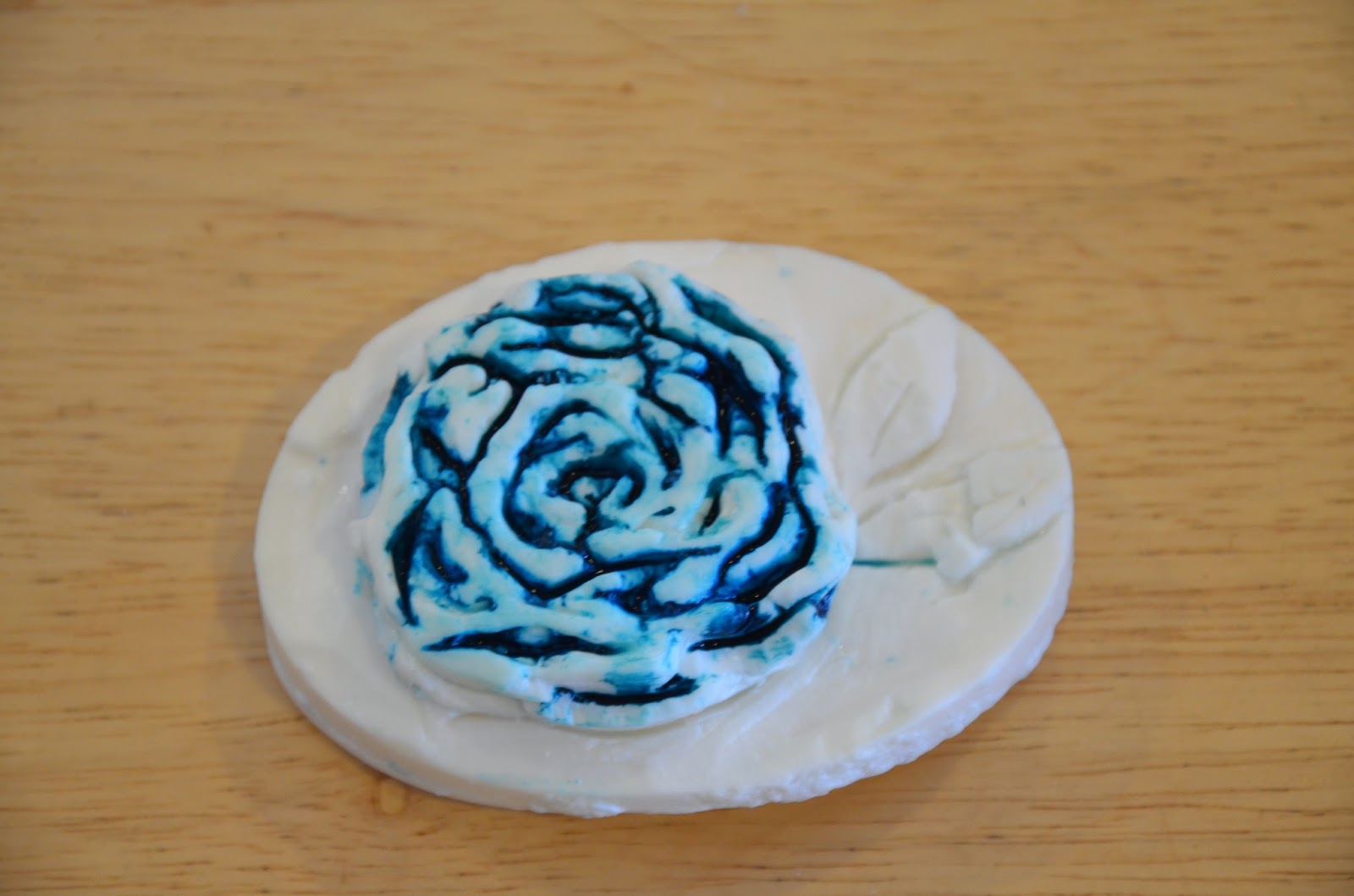
Here's Cathy's beautiful rose
And here it is after experimenting with blue food coloring.  Cool, huh?
But, we won't be actually using this one now...
This was a good time!  It definitely required focused adult supervision -- and the little guys needed help understanding how to do the actual carving, but they caught on amazingly quickly.  As an added bonus, when we were finished, the dining room smelled wonderfully clean -- and the dining room table got a good soapy scrubbing as part of the bargain.  Nothing went to waste, either. We saved all the soap boxes to store the carvings in to be used in their turn at the bathroom sinks (except for the blue-dyed rose, of course), and we saved all the scraps to make hand soap later.

*  Full soap carving tutorial for kids at The Wonder Years .
* Save your soap shavings and make liquid soap when you're finished - as you'll have tons of scraps and it's super easy to do!  Find a good link with tutorials here.

On the Feast of St. Dominic of the Rosary


                            Hymn of St. Dominic

Thou who, hero-like, hast striven
For the cause of God and heaven!
Dominic, whose life was given
Sinners to recall.
Saint of high and dauntless spirit,
By thy vast unmeasured merit,
By thy name which we inherit,
Hear us when we call.

Flower of chastity, the fairest
Of her lily buds thou bearest,
Snow-white as the robe thou wearest,
Gift from hands divine.
With thy brow of starry splendour,
With thine eyes so mild and tender,
Mary's client--truth's defender,
To our prayers incline.

Great Apostle, ever claiming
Souls for Jesus--by the naming
Mary and her Son proclaiming
Mysteries of faith;
Still, O Dominic, the preaching
Of those childlike beads is reaching
Childlike hearts all sweetly teaching
Christ's own life and death.

With those Aves, first and plainest
Of the Church's prayers, thou rainest
Blessings on the earth and gainest
Souls whom Jesus made.
Loving Father I at thy station
Of seraphic contemplation,
In each hour of dark temptation,
Give thy saving aid.


                      Happy Name Day to our Dominic Alan!

Sunday, August 3, 2014

31 Days of Fun: Day 3 -- Hand Clap Games

I was in Kindergarten when my next door neighbor taught me my first hand clap game.  It was Say, Say, O Playmate.  The standard in hand clapping, the lyrics to this game go back to the turn of the century, if not earlier.  Do you remember this:
 (And can you say it without sing-songing?)
"Say, Say, O Playmate..."

Say, say, O Playmate (clap,clap)
Come out and play with me (clap, clap)
And bring your dollies, three, (clap, clap)
Climb up my apple tree; (clap, clap)

Slide down my rain barrel (clap, clap)
Onto my cellar door, (clap, clap)
And we'll be jolly friends, (clap, clap)
Forever more, more...
Shut. the. door!

These hand clap games, like many children's games, have been passed down through oral tradition, mother to daughter, to sister, to friend, to grandaughter, etc. literally over centuries.  It's practically impossible to track down their origins, but it's obvious that a good majority of the classics date to vintage, i.e., before the modern era -- before television, before computers -- back to when children had to find ways to entertain themselves using their imaginations and the resources (ahem) at hand.
Me in Kindygarten

You can tell by the wording of some of the rhymes how old they are. I remember, for instance, being a little kid and puzzling over the words to "Say, Say, O Playmate."    What on earth was a rain barrel, and how exactly could you slide down a door?  I didn't find those things out until I was a grown up and lived in a historic house, but  the weird words were never as important as not embarrassing myself by flubbing up the intricate hand choreography of the game.

Fast forward forty years or so...       .

Here we are, summertime in Nevada, three of our little girls still at home.  I go out to the front porch and -- what is that? -- Drifting over from across the street... I can hear the rhythm of clapping and that same old familiar sing-song tune.  My childhood washes over me like a tidal wave. No way!  The tradition of hand clapping games  is going strong today -- even in the Las Vegas public schools!

Come to find out, our little neighbor girlfriends are experts; they know all the old songs, and some I'd never heard before.  It had been a while since the hand-clapping tradition had hit my radar, though, so I had some catching up to do with our youngest three girls.  I got them up to speed on "Say, Say" and "Miss Mary Mack,"  and they've taken it from there.

And then some.

 I had never actually seen anyone adapt hand clapping to include a third person before the girls figured it out -- but, of course, necessity being the novelty of invention...  Three sisters need to be able to hand clap all at the same time.  Watch their hands fly!

 (Amazing that we started out with Patty Cake when they were wee tots --  and it ramped up to this!)


Miss Molly Mack  (lyrics below)


Say, Say, O Playmate (Lyrics above)


Miss Mary Mack

Miss Mary Mack, Mack, Mack 
All dressed in black, black, black 
With silver buttons, buttons, buttons 
All down her back, back, back. 


She asked her mother, mother, mother 
For 50 cents, cents, cents 
To see the elephants, elephants, elephants 
Jump over the fence, fence, fence. 


They jumped so high, high, high 
They reached the sky, sky, sky 
And they didn't come back, back, back 
'Til the 4th of July, ly, ly! 


They jumped so low, low, low

They stubbed their toes, toes, toes
And where they went, went, went
Nobody knows, knows, knows...

*  Miss Molly Had a Baby (a.k.a. "Miss Lucy") can be clapped to the same tune, and hand choreography.  The crazy lyrics to that one can be found  here.  

*  And a slew of other silly and fun playground rhymes, good for hand clapping and jumprope, too, can be found here.

*  But, the best site, a website devoted entirely to hand clapping games, with lyrics, videos and tutorials to get you started, you can click here to link:  FunClapping.com

* Link to a documentary about the history of hand clapping games around the globe, here.

Saturday, August 2, 2014

31 Days of Fun: Day 2

So what if you're sick of playing in the pool?  Maybe it's just too hot to walk barefoot across the patio to get in it (which it really sometimes is here in the Nevada desert!), or your swimsuit is in the wash, or there's no lifeguard on duty? What then? Well, here's another way to wile away the long summer afternoons:

 Puzzles!

For classic  wholesome entertainment, and an amazing sense of accomplishment when you've finished, you just can't beat jigsaw puzzles!  Puzzles teach hand-eye coordination, attention to detail, and patience.  Don't tell the children, but puzzles are not just fun, they're superfood for the brain!  

Here's the Creepy Crawlies puzzle, first of the summer -- 500 pieces --
completed mostly by Anna, our resident Puzzle Maven.
Then, we worked a couple other puzzles...  a 750 piece and a 1000 piece...
(which, sadly, I can't find the finished pictures of)  The kids put together
each of these in less than a week, each and were working on the 1000 piece puzzle
 when the family descended upon us for our reunion in June.  So, yeah...
 Never finished that one -- and I'm afraid, in all the hustle and bustle,
pieces were lost...  Alas!  One downfall of big puzzles... One lost piece
and the whole thing is rather a wash...

After the disappointment of the crash-and-burn on the 1000 piece jigsaw,
we got this floor-sized puzzle map of the U.S.  With 50 states, 100 pieces,
they finished this one in less than a half hour. And got to work on their
states and capitals at the same time!  Win/Win!
Jigsaws Puzzles can be pretty intimidating, though.  Don't we know it!  Especially if you have a crowded busy house or toddlers around!  But they can be done!  Where there's a will, there's a way!

Here are a few hints to make them work for you:

1) Start small and gauge your time and interest before embarking on larger puzzles. You'd think this would be obvious, but we've made the mistake, ourselves, of biting more off than we could chew.  
   
 * With toddler puzzles, make a mark on the back of each piece with a specific color for each puzzle and
some pertinent initials, so it's easy to get all the pieces back together after your little one has hopelessly scrambled the pieces of 4 or 5 different ones.  Keep each puzzle in its own ziploc bag.

 *  By 4 or 5 years old,  most kids are ready to start with the 25 piece variety, but don't allow them to move up to the next level (50- 100 piece) until you know they're able and willing to complete the whole puzzle -- and be responsible for its proper care. (Proper care = putting the pieces back in the bag by themselves, not leaving a puzzle unfinished and lying around the house, not having a tantrum when they can't finish one, etc...)

    * In most cases, a  puzzle of 500 or more pieces needs to be under the supervision of some one at least twelve years old -- smaller children being permitted to help work it when someone is there watching. More trouble is started by little ones wrecking all the work of the older children.  Make jigsaw puzzle rules and expect them to be abided by!

2)  Keep them safe!  Nobody wants to work on a puzzle (or most people don't, anyway), locked away in a room by themselves.  Puzzles are usually a social cooperative.  But if you have toddlers or a lot of "horse play" in your household, you're bound to have problems! 

*  Dedicate an out-of-the-way corner of a living space, and provide a card or craft table to be used just for puzzles.  Have a Puzzle Table Dedication ceremony if you must, but make sure everyone knows that when a puzzle is being worked, no other activity is allowed on the table.  This will prevent a lot of trouble and bickering, trust me!

*  Make it a hard-and-fast rule:  No playing ball or wrestling anywhere near the jigsaw table.  No forts under the jigsaw table!  (Just trust us on this one!)

* If you have toddlers, especially, invest in a felt "roll up mat," so the puzzle can be rolled up and stored safely away from mischievous little fingers when they're not actually being worked on.  Outside of keeping the puzzle in a locked room, this is the only way to ensure safety from toddlers.  They live to destroy jigsaws!

*  When a puzzle has been completed, carefully disassemble it and store the pieces in a large ziploc bag and put it in the puzzle box, with a large rubber band securing the box.  Stored this way, it can be used again another time. 

3)  Find ways to afford them!  Puzzles are stupidly expensive!  Especially if you have a large family and/or you're trying to be frugal and responsible, entertainment as disposable (or likely to be ruined!) as a puzzle should not take much of a dent out of your budget -- and

it doesn't have to.

 *  You can buy puzzles used at your local thrift store! For obvious reasons, don't ever buy a puzzle in an already-opened box.  But, we never have trouble finding puzzles that have never been opened for a quarter the price of department store puzzles (or less!).  Just check to be sure they're sealed all the way around.

*   If a thrift store puzzle has 100 pieces or less, the management usually doesn't have a problem with you counting the pieces before you buy them.  We did this with the US floor puzzle we bought the other day, and ended up buying it -- in perfect condition -- for $2.99, when school supply stores sell the same thing for $12.99!

*  Share with friends!  If you know someone that does jigsaws, get a cooperative going with them.  Most people are anxious to be rid of a puzzle once it's been worked, and would be happy to work out a trade.  Ask around friends, family, church and homeschool groups.  

4) Have fun with them! 

* There are so many really fascinating kinds of puzzles out there now-a-days, both with beautiful imagery, and cool novelties.  You can find 3-D puzzles, optical illusion puzzles, I-Spy puzzles...  you name it. If you want to invest a little bit of money, the choices are practically limitless. Check out some of these sources:

Staves -- the "Rolls Royce" of jigsaw puzzle manufactures, so says Forbes magazine, and it's a fair title!  Their puzzles are beautiful, amazing, well-crafted -- and expensive! We're not just talking over $100 a puzzle, folks...The cheapest tiny "tidbit" puzzle costs $75, and many in their stock are priced at over $1000!  I personally can't imagine spending this much on a puzzle; these are the puzzles of the rich and famous, I guess. But it's just fun to peruse the catalog, if nothing else!

Springbok.com --  a classic puzzle resource, with a user-friendly online catalog and hundreds of puzzles to choose from, usually under $15.

PuzzleWarehouse -- has a large selection of unusual 3-D puzzles, especially

TheJigsawPuzzles.com -- is an online jigsaw puzzle site, with hundreds of puzzle options!  If you don't have a safe place to put together a real puzzle, or don't want to spend a red cent, here's your prime option.

JigsawPlanet.com -- allows you to make your own online jigsaw, using photos from your own files.

The Toymaker -- has templates that allow you to create real puzzles of your own, using your own images.

*  Most of all, try to make puzzle-working an enjoyable time for the whole family, not a one or two person hobby, fraught with tension and misery.  Make the rules to help protect your puzzle, but try not to get all bent out of shape when children forget rules, or cats jump on the puzzle, or teenagers spill soda on it, or a piece or two end up on the floor -- or get lost altogether... Because, guess what?  It's going to happen.  But, it's a game, not NASA launch plans.  Try to roll with it, when the inevitable happens.  Keep your cool and teach your children not to freak out.  

Even if they get down to the 999th piece of a 1000 piece puzzle and can't find the last one. Take it seriously but keep it light, and don't let them turn over the puzzle table in disgust. No missing-piece puzzle tirades are allowed.  This is the greatest challenge of jigsaw puzzles, my friends.  It's the real test.   (And you thought it was trying to match up all those tiny little interlocking pieces, didn't you?)

Friday, August 1, 2014

31 Things to Do in August

When you live in Vegas, where the thermometer hits 100 degrees almost every day -- and you have a postage-stamp-size yard and very little money....  BUT have a good handful of siblings, a swimming pool, and a whole lot of imagination....

You Can Do This


Day 1: Starting With a Splash!


Granted, most people don't have swimming pools in their back yards.  We've never had one before this rental house, and after this rental house, we probably never will again.  But we're making the most of it while we do have it!

In normal times, though, when we didn't have a big pool, we always had the little cheap Walmart variety wading pools to help take the heat off of long summer afternoons.  It was always great fun for a while, but it was inevitable that, after the first handful of play days in the little wading pool, it got a little boring.  The novelty wore off pretty quickly; there's only so much splashing of siblings you can do before it gets old hat.  By August the wading pool had usually blown under the edge of the bushes in the corner of the yard, abandoned, forgotten, with a layer of dried up dirt in the bottom.  And the children were wandering around complaining that they didn't have anything to do.

But it doesn't have to be that way!  Here are a few ideas to keep the wading pool out from under the bushes and in the middle of the action through the end of the summer.

Ten fun things to do with wading pools:

1.  Bring indoor toys outdoors.  Bath toys, plastic pirates, army guys and little boats and ships or tea sets and plastic dolls take on new life in a new setting.  Provide the props and let the children do the rest!

2.  Play: Will it float?  Especially for younger kids, this is Science in a fun wet package!  First,  prowl around, indoors and out, looking for different kinds of flotsam and jetsam to throw in the pool, one at a time. Ask the question of each object:  Will if float?  Let the kids guess, then see who's right!  There are tons of links to flotation experiments and explanations for children, but here are two to get you started:

* Here's a scientific explanation for boyancy: here
* The younger kids' version is here 

3.  Once the children have the floating concept down pat, they have the knowledge necessary to build "floating islands."  Find several large tupperware-type lids (or storage container or pot lids), add a bunch of blocks or leggos and some "action figures" of some kind.  Race car tracks make great bridges between islands.  Make a game out of seeing how high or elaborate the children can build the structures on their islands without sinking them.  (Make a rule that no one is allowed to fuss when their islands tip.  It's part of the game!)

 4.  Empty and clean out your wading pool.  Fill the bottom with several  salad-plate-sized blobs of finger paint  (homemade finger paint recipes here).  Prepare unfolded old cardboard boxes over a nearby tarp or old plastic tablecloth or shower curtain. Alternatively, just use the tarp or solid color shower curtain as your art space.  Then, you know what comes next, right?  Let the kids go wild with footprint and handprint designs.  (Keep a hose nearby and make rules about where they're allowed to walk around!)

5.  Make a bubble bath out of it, adding standard bathtub bubble solution while you add the water from the hose on as high a stream as you can.  The bubbles will only last a little while, but it's big fun while it lasts!

6.  This is a more permanent use for a wading pool, but a fun alternative, especially if you have two pools.  Turn it into a sandbox!  It's cheaper to buy sandbox sand in bulk if you have a truck to haul it in, but it's not terribly expensive just to buy several bags at the hardware store.  Add a few dollar store buckets and shovels and maybe a few matchbox cars and you're set to go!

7.  Provide the makings for a "water feature" in your pool.  Purchase a few pieces of pvc tubing and connector joints, add a couple funnels and buckets, and pull some lawn furniture close by for propping. A little blue painter's tape is helpful for holding up the tubing, too.  Let your kids figure out what to do next.

8.  Use your wading pool for "target practice."  Using bendy straws -- or even better, dollar-store glow-in-the-dark "necklaces" that hook togethe --, make two or three floating "hoops."  Gather up a couple small "bouncy balls."  Draw a line (or use a jump rope) to mark a reasonable throwing distance based on the age and skill of your children, then have them take turns trying to throw the balls into the center of the hoops.  If some hoops are smaller than others, they can be worth more points, and scores can be tallied.

9.  For older kids:  Make Soda Bottle Submarines!  Buy the kit, the cheater's way, by going here.  Or do it yourself, as described here.

10. For kids of all ages:  Make Milk Carton Paddle Boats!  Easy instructions here.

* Get out there, get wet, have fun, and stay cool!

(Note:  This was a brain-storming session the kids and I had about what could be done with a wading pool!  We may be revisiting some of these activities this month, adding pictures and more complete instructions as we actually DO them as part of our "31 Things"...)

Duckmato


Whenever I see something so whimsically unlikely,
 I assume that there was a Guardian Angel of a good little child
 with time on his hands